Navigating Developer Challenges When Linking Payment APIs to Merchant Account Structures for High-Volume Retail Operations
Yves Washington · Jun 26, 2026
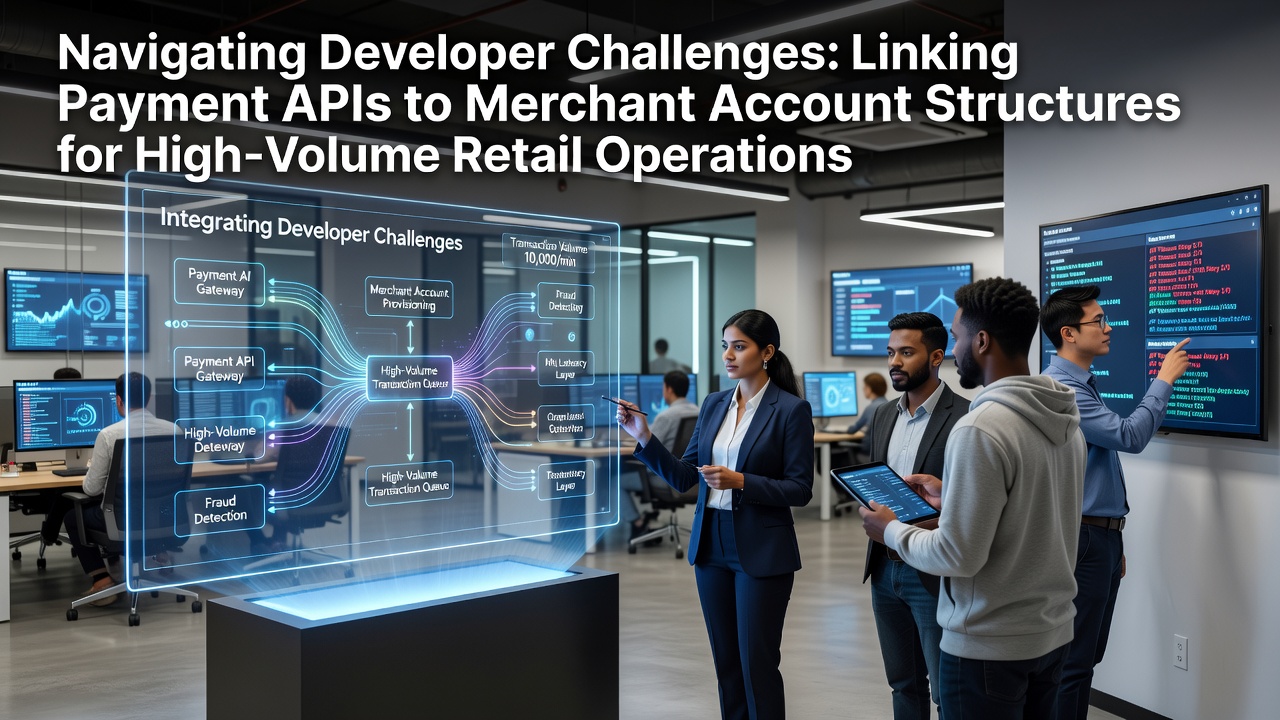
Navigating Developer Challenges When Linking Payment APIs to Merchant Account Structures for High-Volume Retail Operations
High-volume retail operations depend on seamless connections between payment APIs and merchant account structures, yet developers encounter persistent hurdles when scaling these integrations across thousands of daily transactions. Systems must handle rapid throughput without latency spikes while maintaining strict separation between transaction data and account ledgers. Research from the Federal Reserve indicates that retail payment volumes exceeded 200 billion transactions annually in recent periods, placing direct pressure on API endpoints that interface with merchant accounts.
Scalability Pressures in API-to-Account Mapping
Developers often discover that standard API rate limits clash with peak retail demands during sales events or holiday rushes, forcing custom throttling mechanisms that sync with merchant account approval workflows. These setups require dynamic session management because merchant accounts typically enforce velocity checks tied to business verification tiers. When volume surges, the mapping logic between API calls and account profiles can create bottlenecks if database queries for account status updates are not optimized for concurrent access. Observers note that load testing conducted in controlled environments reveals failure points around the 5,000 transactions-per-second threshold without proper sharding of merchant data stores.
Security Protocols and Compliance Layers
Linking payment APIs to merchant accounts demands layered encryption and token handling that aligns with PCI DSS requirements maintained by the PCI Security Standards Council. Developers implement end-to-end encryption for card data while ensuring merchant account structures store only tokenized references rather than raw credentials. As of June 2026, updated compliance frameworks emphasize real-time monitoring of API traffic patterns to detect anomalies that could indicate account compromise. Multi-factor authentication flows between the API gateway and merchant onboarding systems add another integration layer that must remain resilient under sustained load.
Integration Complexities Across Account Hierarchies
Merchant account structures frequently incorporate parent-child relationships for franchise models or multi-location retail chains, and API integrations must propagate authorization decisions across these hierarchies without introducing race conditions. Developers address this by building reconciliation engines that match API response payloads against account ledger entries in near real time. Data synchronization routines become critical when settlement cycles span multiple time zones, since discrepancies in reported balances can trigger account holds. Those who manage these systems report that using event-driven architectures helps maintain consistency, yet debugging distributed transaction failures requires specialized logging tools that correlate API request IDs with merchant account audit trails.

Configuration drift emerges when merchant account settings are updated through separate portals while API clients retain cached credentials or routing rules. Automated validation scripts that poll both the API configuration endpoints and the merchant account dashboard help surface mismatches before they affect live transactions. European Central Bank guidelines on payment service integration highlight the importance of standardized error codes that allow developers to map account-specific rejections back to API responses without custom translation layers.
Testing and Monitoring in Production Environments
Simulating high-volume scenarios during development proves insufficient when real merchant accounts enforce live risk scoring models that adapt based on transaction history. Developers therefore deploy canary releases that route a controlled percentage of production traffic through new API-to-account mappings while monitoring settlement success rates. Observers note that synthetic transaction generators must replicate the exact payload structures accepted by merchant acquirers to avoid silent failures during reconciliation. Alerting systems tied to both API latency metrics and account-level decline rates provide early warnings when integration points begin to degrade.
Database connection pooling strategies require careful tuning because merchant account queries often involve joins across multiple tables for fraud scoring and limit verification. Connection exhaustion during flash sales has been documented in retail case studies, leading teams to implement circuit breakers that gracefully degrade non-critical features rather than dropping transactions outright.
Conclusion
Successful navigation of these challenges hinges on coordinated development practices that treat payment APIs and merchant account structures as interdependent components rather than isolated systems. Continuous alignment between technical implementations and evolving compliance expectations supports stable operations as retail transaction volumes continue to grow. Data from industry reports shows that organizations investing in unified monitoring frameworks experience fewer integration-related outages over multi-year periods.